My encounters with libertarians and objectivists lately boil down to "You have to read so and so's book and then you'll understand", with the implication that until I read it I cannot comment on the ideology/philosophy and they do not have to discuss it with me. A clever way to end an argument, but also fair enough, one should read the texts of your opponent. What they don't count on is that I'll actually read it AND detail out a critique on the book. I read fast and I read often.
I'll say straight away that I do not disagree with the entire libertarian position, but I disagree with enough of it (basically anyone who tells me that greed is a perfectly acceptable way to run their affairs. NEWS FLASH: it isn't). The following is notes I made on Milton's writings and the page numbers where he expressed the ideas that triggered my comments.
One complaint about the way I have laid this out is that it may not be all that intuitive to those that do not have the book handy what I am commenting on. To which I would reply that a) I do make some effort to frame Milton's thoughts that I am responding to in my critique and b) this is for people that either have read the work or have a copy and c) this also is my way of saying I have read the work and done the work, so fully regurgitating Milton's work is not necessary nor is it desirable (as this is bloody long enough already).
Introduction
Pg. 2 Refers to Adam Smith, no force no coercion. Adam had no idea about corporations, monopolies or cartels. For example, Section 34 of Rogers TOS, states that they have the right to charge a customer for 30 days of service or when service is cut off, whichever is later, which means by default you are paying for 30 days of service which you will not receive. If it is larceny is the industry standard you have no choice but to submit to which is thus an unequal bargain.
Pg 2 Thomas Jefferson "We hold that...". Jefferson was a rich white slave owner. Rights in his view were qualified. Economic rights are still qualified.
Pg 3 Economic and political power in the same hands is a recipe for tyranny. He is referring to centralize government but his argument equally applies to Transnational Corporations (TNC).
Pg 4 It is ironic that Milton (MF) on the one hand preaches for a small weak government but on the other hand blames the government for weak policy that lead to the Depression. For a man that places such emphasis of personal responsibility and individuality to blame the government for people taking advantage of lax monetary policy is somewhat ludicrous. I'm not absolving the governments role, but blame must be properly apportioned.
Pg 4 Hayek’s argument that the early success of political and economic freedom lead to the increasing intolerance of perceived evils of inequality and taking advances and prosperity for granted. That is one way of looking at it, the other way of looking at it is our species is maturing, attempting to find the meaning of the word “enough”. Hayek would have us go backwards.
Chapter 1: The Power of the Market
Pg 10 Irony: Milton uses example of a soviet appliance breaking down and how long one would have to wait to get it fixed, this is no different than planned obsolescence in capitalism. Soviet system was better defined as state capitalism than communism. Instead of profit it had production quota’s.
Soviet model not efficient: based on what metric? The West's? From a profit perspective the soviet model was not efficient. Soviet was a growth economy like capitalism, it needed better feedback mechanisms and would have made a better steady state economy.
Pg 11 Correction: not a single person can make an industrially produced pencil. It has more to do with access to capital than actual know how.
Pg 13 Prices disconnect ourselves from the product and its production. Milton says it himself when he says we have no way of knowing where the product comes from. This is necessary in an economy where the players do not know each other which is the environment of TNC and this allows for the players to get away with all sorts of shenanigans to make a profit. If all the end consumer knows is price, the actions taken to deliver that price become irrelevant in the decision.
Pg 14 Prices: transmit information, they chose the least costly production method, they distribute the product (via income). Demand has no way of knowing it's impact on the environment as prices will be reasonable along most of the depletion curve.
Pg 15 Then what is advertising if not clogging the “in” baskets? Advertisers have no way of knowing if someone is in position of acting on the information or not as they spam the ether with their message. Price might be a simple means of transmitting the information because of what it transmits is so narrow to the end user, but the information that makes up how the price is arrived at is lost in the act of translating it into dollars and cents.
17 comments on OPEC but says that government interference is more important in price distortions than private. What about private interference in government?
18 Makes the case that all price information assumes a social good. If the incentive increases (i.e. Price) does that mean it is socially good to fulfill that demand? What social good is fulfilled by products made for one disposable and destructive purpose, i.e. military?
21 Human capital is more costly to maintain and replace than physical capital, so it is an incentive in any business to reduce the reliance on human capital.
23 Price essentially determines the worth of a person. It might be fine if price encompassed all areas of life but the economy routinely does not assign value due to conceptual problems. Assumes that without price as an incentive no saving would be done, so what did we do before money, starve? Assumes no dangerous work would be done, the incentive without price becomes the true incentive, make the work safer. False binary choice offered the only alternative to free market is command economy.
24 He makes a false analogy between everyone owning something and the state owning something. If everyone who lived in the housing had a hand in building it, the level of investment changes.
33 MF blames the weakening of familial cohesion on government paternalism when in fact the reason why family is weakening is because of the culture of robust individualism brought on by an economic model predicated on continual growth, in short the richer we are the more we substitute money for relationships.
Chapter 2: The Tyranny of Controls
40 Capital chases the lowest cost of labour. Every country has a poverty line. If, as MF previously argued, price is a reflection of cost and must be reflected in income, how does it make sense to undermine the means to earn income to gain a small cost advantage. People in general would be willing to pay more for products if they had a good paying job. Since people are price takers, they by default seek the best deal, to channel this behaviour, tariffs are needed to raise the cost of the imports above that of the domestics.
41 The only reason imports and exports make sense is because of the valuation of oil. It is underwritten by mass quantities of cheap energy. In an energy scarce scenario, you produce everything you can locally and import those thing you are unable to produce.
42 Surely he knows this argument is a farce. He should use another currency as an example. Any other currency but the US dollar. As the reserve currency of the world, there will always be a demand for it as long as oil is priced in dollars. The US doesn't have to manufacture anything as long as they maintain their dollar hegemony.
44 So to destroy comparative advantage all we have to do is what exactly? Why is an American worker 1.5 times more productive. Not because he is American, but because of information asymmetry which is protected through proprietary law. If we shared out the knowledge and best business practices, the only comparative advantage that would remain is a willingness to accept low wages and geographically located resources.
52 Britain version of free trade was mercantilism, essentially funneling goods from their colonies to the motherland while impoverishing the same colonies. The "collectivist" state of Hitler's Germany is more astutely framed as the reach of corporate power into the state, the very image of crony capitalism, which is defined, coincidentally, as fascist. Also consider why WWI started, not because some second-tier noble got assassinated but because of Germany's rise to power with the adoption of the American system of economics (which relied on infrastructure development and heavy use of tariff's). This threaten the balance of powers strategy that the English and the French had been employing for centuries.
54 Blames monopolies and cartels on govt regulation/interference. Once again, the cart is before the horse. Govt is an intermediary. Emasculate govt and TNC's would do it directly.
64. I would ask MF where the majority of the govt intervention goes on to benefit? The rich and the corporations. Follow the money and you'll find the root of the problem. I never see libertarians or objectivist protest that vigorously when the rich and too big to fail get bailed out, but talk about food stamps and holy fuck get out the pitchforks, we are going to a commie roast!
66 MF does not acknowledge the imbalance of power between employer and employee.
68 Portrayal of oil execs as victims is laughable. The oil cartel has the strongest lobby in the world, the have direct access to politicians which circumvents one person one vote. They effectively write oil legislation and in fact support regulation as it prevents new market entrants i.e. Porter's five forces.
69 MF goes on to rail against unions and blames govt for their power. All rights and obligations are codified in law and MF has no concept of the history of the struggle labour had to go through to gain these rights.
Chapter 3: The Anatomy of Crisis – No notes, basically the history and use of the Federal Reserve and it’s impact on the Depression.
Chapter 4: Cradle to Grave
98 Does MF not see that his words also apply to corporations? Who do corporations represent if not the predominately rich?
105 What is the point of the moral outrage? "people who would not lie to their children are lying to us...". Is useless rhetoric, meant to persuade by emotion not convince by way of reason.
106 MF thinks moral responsibility ends at the individual. He uses the example of children helping their parents out of love, depending on the same familial bond that has been weakened by robust individualism that he blames on gov’t paternalism on pg 33. What of those that have not even a familial bond, i.e. orphans? In MF’s view, no one needs to take responsibility for them as moral responsibility is individual and by extension familial. Doing the right thing shouldn’t be portrayed as a choice, as it never is a legitimate choice. Should I feed these starving people or should I ignore them and let them starve, this is the choice that MF wants to legitimatize.
107 Director's law. A middle class conspiracy against the rich.
108 MF complains about welfare programs, let us talk about tax cuts for the rich and increase in non-productive military spending. You’ll find that almost every tax cut for the rich and increase in military spending was partially bankrolled by cuts to social spending. Additionally, MF can include income “in kind” when he finally stoops to working out the "conceptual" problems of imputed labour for housework, specifically women's housework (Counting For Nothing, Marilyn Waring).
110 MF has no idea what causes crime. He thinks it is from getting welfare handouts and subsidized housing. So getting rid of government is going to fix crime? Crime is primarily spurred on by poverty and inequality.
122 Negative income tax. Why does this remind me of England's "solution" to poverty in the 1600's, the poor houses? MF seems to believe that people love being on welfare and that if we help them too much they will not bother to help themselves. This isn't true by and large. You'll find a few exceptions but the majority of people wish to be independent, self-sufficient, and feel like they are worth something. A negative income tax won't give them that, even welfare doesn't give them that.
123. MF assumes that private charities will step in to fill the void. The common argument is that communities stepped in to help out before there were governments. This is true, but with the onslaught of ever increasing debt, work hours, two income families, communities have been reduced to neighbors with tall fences. Socialism by government stems from the fact that communities do not/cannot do it anymore. If you want communities/private charities to fill in the gap, then you must reinvest in communities again. Otherwise negative income tax schemes and offloading social concerns on localities smacks of rich people not wanting to pay for well-being of poor people thereby perpetuating the inequality gap.
Additionally, if MF is such a big believer in social and economic Darwinism, why have the “superior” solutions of private charities not overtaken and out-competed the current model? For that matter why have free markets never materialized?
124. He makes one think that it is a free choice how one chooses to fund their retirement. It is a free choice to those with money, does he think that a negative income tax will for someone who is impoverished for most of their life, cover their retirement? Perhaps MF thinks private charities will plug that gap too. Out of sight out of mind. And for an economy that is 3/4 driven by consumer activity, how much capital formation does he expect to take place in an already credit drenched, over extended society?
125. Again radical welfare reform is no different than the rich aristocrats deciding that it was necessary to allow the poor to starve, because without hunger, how else do you expect the poor to work? Asinine. Give a person useful work, give them a sense of purpose, allow them to have some say in how the work is accomplished and that is all the motivation they need.
Chapter 5 – Created Equal
128. Setting up a straw man with equality of outcome. No one expects income distribution to be equal for all players. If you work hard and/or are brilliant you should keep more. Where I take issue is when the rich who may or may not have even worked for their wealth think they can pay proportionately lower taxes than the middle and lower incomes. They are under the impression that they earned the wealth all by themselves when in fact they are wealthy partly because they are hardworking/smart/lucky but also because the environment in which they work is conducive to allowing you to make income. Which is paid for by everyone who can pay, proportionately. When I hear about billionaires who are leaving the country in which they earned their wealth because they do not want to pay their fair share, it strikes me as profoundly ungrateful. You make it and you pay it forward, if you don't the alternative is unrest.
129. Thomas Jefferson = huge irony.
131. Inequality with freedom is an oxymoron. The poor have no freedom in poverty, their every action limited by debt and lack of money. The rich seem to be more free physically, but as a minority they have to spend their lives using their wealth as leverage to insulate themselves from the masses. Ever fearful that those beneath will rise to take from those above. Hence we have authors like Milton Friedman, Ayn Rand, Frederich Hayek, Bastiat all justifying the inequality by calling it just and natural and condemning any notion of what is fair as collectivism.
135. Fairness is proportionality. If a middle class person is expected to pay up to 40% of his income in taxes how are we to view a rich person paying an effective rate of 17% as fair or just? Basically MF says that if we don't allow the rich to keep almost all of their money then how else are we going to make the producers produce. At a certain point, vast amounts of money is pointless and more than a little obscene. A doctor make $250K to a couple million a year is just and fair. They provide a much needed service and should be paid commensurate with their experience. A hedge fund manager taking home 10's of millions as a bonus is unnecessary since they do not also assume the downside. The bonus is privatized but the loss is socialized. But in any case both the doctor and the hedge fund manager should pay a proportionate amount in taxes.
136. Ludicrous. Find me someone who actual supports this position that those with talent should be encouraged less than those without? Common sense recognizes that everyone has different strengths, you emphasize the strengths and compensate for the weakness as best you can, no one suggests holding people back. Why else would we live in such a fiercely competitive society with such a fiercely competitive economic system?
137. MF is leading into social Darwinism here. The desire for a society for less inequality doesn't arise because we want to compensate for the lack of nature's gifts, but because we want the security to live with dignity. MF should remember this feeling from his own poverty, but like most formerly poor he wishes to forget his own poverty and protect his new-found wealth. About Ali, what do you think he fought for before he climbed the ranks, about the pay of a dockworker.
139. Rockefeller Foundation, founded as a PR stunt after shooting down union members. MF says there is no inconsistency between the free market and compassion. Perhaps he meant to say there is no intersection between the FM and compassion. One is performed outside of the other, there is no profit in compassion, that is a social decision we make is not a rational market decision. If (rich) D deciding what he will do for (poor) A worked so well, then why did it become necessary for B and C to decide for D? Could it be that D could not, for self-interest in maximization, make the right and just decision? When you espouse a philosophy that puts a premium on self-empowerment and bearing the consequences and fruits of ones own decisions, how do you possibly expect the charitable response of individuals to play out in a positive way?
141 Rather than going on about equality of outcome, how about equality of dignity? As anyone who has had to live only by the sufferance of those better off, dignity is by far the most important virtue and the very least any civilized society should offer without question or judgement: food, drink, medicine, shelter. Something the rich of our society lack is humility, a very Christian virtue. When freedom takes on the shape of one individual buying their own private island while millions starve, this is without question an egregious form of violence. At the very heart of it, when an executive purchases their own private jet, they are saying that the millions of starving are worth nothing. How to rectify? Live reasonably, buy goodwill with your largesse. What is "reasonable" is what is proportional to your wealth. Are you worth a billion dollars, perhaps living on 10% of that is reasonable. And with the other 90% do good works. This is what it is like living in a siphon society as opposed to a funnel society.
142 No one goes into public service to get rich. There are two types of people that go into public service, those that want to do good, and those that want a particular piece of legislation. Also there is no equivalence in the argument of wanting less inequality and wanting everyone to be equal, MF is attempting reductio ab absurdum, but it is in fact another straw man. Under no circumstances do I think a doctor should be paid as much as a waiter. I would be interested to see just which egalitarians are making this argument as MF refers to them, but not by any identifiable name, which makes me think, they do not in fact exist. Also if voluntary redistribution worked in a capitalistic, competitive society, we wouldn't need compulsory taxes to accomplish what must be done and make no mistake, historically speaking, some redistribution must happen to protect the wealth of the upper class. You see this with debt jubilee's, relaxing of debtor laws, granting of labour rights, granting of legal status.
145 Crude criminality does not stem from a drive towards equality (even his equality of outcomes) is stems from deprivation. Poverty is the source of crime, reduce poverty you will reduce crime.
146 Interesting MF uses the words "permitted" because indeed a free market must be permitted by law (imposed) to operate or else it would not exist on a grand scale. Polanyi illustrates this in The Great Transformation, free markets imposed by law, and the spontaneous social action that arose to stop it.
147 So what MF is describing when describing Russia is not an egalitarian society, it is in fact no different from the gradients of poverty and wealth seen in any capitalist society with the exception of a significant middle class.
148 Does not the accumulation of wealth and property require force as well? Force to earn it and force to keep it. And by its accumulation, does it not inflict violence on others so deprived to sustain such wealth?
Chapter 6 – What’s Wrong with our Schools
153 The public school system was a reaction to increasing industrialization. Business's required that people have particular skills, but not a wide range i.e. critical thinking. They needed factory workers, not scholars. MF typically blames the gov't when in fact he should be pointing the finger at business.
157 We have to tolerate some inefficiencies from an economic perspective, because a) markets do not internalize all costs into prices b) because some things that are important to our society are external to the market thus unimportant i.e. the environment.
161. Quality of education is deteriorating because it matters less now to business whether kids graduate. The market for those skills has collapsed with outsourcing and automation. The kids that do go on to college and university are enough to satisfy the knowledge and service industries’ steadily shrinking market.
168 Coons and Sugarman are right. For a man who denigrates the Govt so much MF seems quick to allow the Govt to subsidize the choices of the rich. The term economic segregation is clear enough, those that can already afford private schools will then use govt vouchers to drive up the price of the private schools keeping them out of reach for the poor. In essence, nothing changes for the poor except the rich no longer have to directly subsidize their education.
169 Perhaps in America where social costs are frequently a target of politicians looking to make cuts to support tax cuts for the rich and increased military spending, but in other places in the world, socialized education works i.e. Canada.
177 He characterizes state run colleges and universities as places where slackers go to party and drop out. He has no idea why students drop out, but considering most of the students come from a class that can't afford ivory tower tuition, I would hazard to guess money and opportunity are the main reasons for dropping out, a much more plausible reason than laziness, and partying.
179 The invisible hand or the invisible fist? MF makes the argument that education should be primarily available to those with the private incentive to get it i.e. money. I would make the argument that education should be primarily available to those with the interest and the ability. Money should not enter the picture. Since we both agree that education serves both the public and private interest, money should not be the bottleneck that bars the way. His argument that those that go only because it is subsidized do not value it as much if they paid and could pay full cost. He uses the word “willing” and misses the word "able". That is like saying a starving man will not value a subsidized apple because he cannot pay the full cost. Best way to keep the lower classes in their place is to put education out of their reach. What does MF feel about libraries I wonder? Probably don't trouble him much because a library cannot confer a piece of paper that says you know something.
184 In quoting the U of C study he makes it seem like the rich and middle class are having a joke at the expense of the poor. If the poor are not receiving proportional benefit from the subsidy then how by raising the costs of education will it make it more accessible? There are currently private institutions but not one of them is cheaper than the subsidized state run schools. Also let's address the reasons why the poor may not be taking advantage of the subsidy. They may be ill-prepared from a life of deprivation or more likely they are working three jobs to makes ends meet and have not the time or money to avail themselves. Pay or borrow for higher fees. Hmmm trillion dollar student debt bubble? MF hates it when regulations hold someone back but seems to have no problem with money being the gatekeeper. Sure let investor's invest directly in the student by buying a share in future earnings. That has no possibility whatsoever of being abused. /sarc. It is slavery by another name.
Chapter 7 – Who Protects the Consumer?
191 Shout out to EF Schumacher. I do agree that regulation has gotten out of hand. For every regulation/law proposed, 2 should be repealed.
192. How does MF explain planned obsolescence? Government made products tend to be made to last so as not to have to pay for more of the same. It usually involves higher upfront costs, but they last longer. An unfortunate example that comes to mind is the AK-47.
197-199 All I see here are businesses that couldn't accept the free market and tried to circumvent it at ever turn. They found that government is the perfect tool.
215 He blames consumers for pollution not producers. This is not a chicken-egg argument. Beyond our necessities for life, food, drink, shelter, all wants are manipulated by producers advertising their product. How could a consumer want an iPad if none had ever been produced? He is correct that the cost for cleaner air and water must be born by the consumer which leads to another problem inherent in our economic system: inequality. When the gap is so great the amount the majority would have to pay exceeds their ability to sustain themselves. For example pollution primarily driven by China and the US affect the climate in Africa, how are the Africans to pay to offset the effects of pollution when they cannot feed themselves? The rich routinely make decisions with "their" wealth that have real implications for the rest of us. If Director's law is an issue then does not a proportional graduated tax address this? If most regulations benefit the rich and middle class and they pay the greater portion of the taxes proportionately, then what exactly is your beef?
217 Cheapest way to keep down effluent is illegal dumping. You only pay if you get caught.
218 Comparing horseshit to automobile exhaust. I realize this book is somewhat dated, but I can't help but say horseshit never contributed to climate change.
220 I would be interested in MF take on the DEA. I have often thought about the conflict of interest of prosecuting the war on drugs which has essentially grown from a budget of 100 million in 1973 to 20 billion dollars plus today.
222 Private enterprise will never mobilize capital for a profit loss scenario. They cannot. And there are many situations in which governments need to mobilize capital in scenarios in which their can be no profit.
224 Edward Bernays would heartily disagree. We are profoundly influenced by advertising and by others. If we were not then why did MF bother to write this book? It is advertising, some would say propaganda, but it influences none-the-less.
225 MF solution to monopolies is not legislation, it is opening up to international trade. Now I have an unfair advantage because I have the weight of future (his future, my past) events on my side, but how did he not think that same scenario that lead to national monopolies would not also lead to international monopolies/cartels? Introducing the Transnational Corporation.
227 I agree with his alcohol/drug policy.
Chapter 8 – Who Protects the Worker?
228 MF is being deceitful. True, officially recognized unions were few and far between, but union-like behaviour, strikes, work slow downs, protests, petitions existed for a long time and in great numbers. It was workers banding together that won better working conditions long before the govt gave them legal status (indeed the gov’t often sided with the owners). Any other view on this is ahistorical.
229 It was workers willing to stand up to government and capitalists that won the rights and enhanced the working conditions of all workers whether they were in unions or not.
231 Designating the Hippocratic Oath as a precursor to the first union. Paranoid? Just like we wouldn't let just anyone call himself a doctor today, they wouldn't back in ancient Greece. We require competence in our doctors.
232 Apparently the high wage earners in MF's world are those that are part of unions and those that are part of govt. Who are the highest paid workers in the world? CEO's of private companies.
234 Note: I am more than 2/3 of the way through and I do not believe I have heard MF once address military spending. He only attacks social spending. In fact, except for a brief swipe at GI benefits, he goes out of his way to exclude the military from his numbers.
In his argument against unions (union employ fewer people at higher wages forcing people to seek work elsewhere, their numbers bidding down non-union jobs) exposes the same flaw with international trade. Labour, a commodity, gets traded like anything else. Capital chases the lowest cost of labour. Hence access to greater pools of labour (i.e. displaced Mexican corn farmers) drives down the cost of labour. Another thing MF misses or doesn't address is that we need less labour overall due to innovations in technology and energy use. This, combined with access to global labour pools, drives down wages. Unions make up a small portion if anything.
MF says that all raises come from the productivity dividend. It used to, now it goes primarily to SH and management. Any raises that do come now, mostly come from inflation.
Raises in excess of productivity would come from other workers. I can agree with that as it explains the increasing pay gap between management and front-line workers.
235 We all wear the consumer hat at sometime. But in this economic system we must wear the worker hat first before we consume. So giving people high wages, as long as prices are affordable to those wages is no loss. High wages requires that the productivity dividend is shared out more fairly and not hoarded by owners and management.
MF says unions and governments are in cahoots. Laughable. And completely ahistorical. I suggest Howard Zinn’s A People’s History of the United States for a real picture of the governments relationship with unions.
236 Again he complains of the violence used by unions to enforce their demands. MF is either ignorant of history or being willfully deceptive. The violence perpetrated against workers by both owners and govt far exceeded anything workers have done. Any violence would have been in reaction to injustices inflicted upon them. MF perhaps is affected by the hierarchy of force. Any violence that travels down the hierarchy from the upper class to the lower class is acceptable, routine and often invisible. Any violence traveling up the hierarchy is shocking and very visible. Any violence traveling in the wrong direction is dealt with harshly and immediately.
237 I address the minimum wage argument of Jacob Spinney and others in prior post here. They are MF's arguments verbatim.
243 MF takes umbrage at the idea that anyone's salary or pension should be linked to the cost of living. What is the alternative that it should be linked to the price of malnutrition? Anywhere there is inflation wages should be adjusted to compensate to preserve purchasing power. I suspect that the outrage is because to link wages to inflation removes the ability of capitalists to give “raises” that are funded by an increase in the money supply and not from the productivity dividend.
Also just how common was workmen's comp in the private sector, before it was legislated?
246 MF assumes that there is equal power between employers and employees. How could that possible be the case when one sells commodities and one is a commodity? If the supply of labour is greater than the number of jobs and in a global context it always will be, then the employer has more power. MF also assumes that the employee is more mobile than the employer, this is no longer the case when a TNC can move its headquarters through filing some paperwork across international borders, in one day. Lastly, it is a requirement that one works to live, people need money more than employers need people.
247 MF reinforces that the free market and competition lead to growth which provides the excess needs for raises. But historically we know that markets don't always grow, of course MF would maintain that there has never been a true free market, the “No True Scotsman” argument. But his free market experiment got played out again and again through Jeffrey Sachs use of "shock therapy" in places like Bolivia, Argentina, Chile, Poland, Russia. It turn out to be pretty good for the rich, not so good for everyone else. And there was nothing voluntary about it. Most packages were created in secret and rushed through voting and had to be enforced forcibly.
Chapter 9 – The Cure for Inflation
254 So far I am mostly in agreement with MF's analysis of inflation. He seems to put the blame squarely at the govt feet, but recall, in the US the Federal Reserve makes monetary policy and the Federal Reserve, despite it's name, is a private institution that happens to have a monopoly on the creation of US currency.
268 The product and placement paid for by printed money matters. To take MF's example of workers building a road where none was before. If the road was built in the middle of nowhere and of little use, inflation will most definitely result. If the road was built to connect a town that up till that point had to pay to fly products in, then the cost of transport will dramatically fall, driving down costs and more than offsetting any inflation and everyone is better off.
283 I wonder if MF thinks centralize spending for the military is socialist?
Chapter 10 – The Tide is Turning
286 Maybe that is the problem, we can no longer have parties of principle but rather expediency and compromise. What are we expediting and with whom are we compromising?
291. Isn't he also describing how the free market works. Do not products work cross-purposes to each other? MF has no problem with waste as long as it is voluntary and in the confines of the free market, because he does not castigate all the legions of free market capitalists that have lost their shirt starting a business that failed. How many start-ups succeed? Something like 10%.
Thought: could the free market solve an impending meteor strike?
305 If price is speech then why is it so garbled?
309 For a word he uses so often did he define what "freedom" means?
Sunday, September 02, 2012


Friday, July 27, 2012
Economics is Backwards
Our economic thought is backwards. For hundreds of years we’ve developed and advanced a method of thought that, in the aggregate, results in overshoot, overpopulation, overthrow.
How could such fundamental errors have occurred? Easy, when formulating a hypothesis as to how the world works, the context of the history is extremely important. The environment on which the modelling is performed is not static, thus the model should not be static either.
The context is the cultural/social milieu, and the period, a time when the riches of the new world have been virtually untouched. You can make egregious errors in concepts and logic without suffering from the impact of that error as it is not apparent and will not be apparent for hundreds of years. It seems like the system works until it doesn’t. What is then is prescribed is more of the same, because that is, after all, what has worked in the past.
So what was the error? The classical economic system has as its foundation, labour, land, and capital. With me so far? The neoclassical economic system is structured thus; labour and capital with land as a subset of capital.
See the problem? No? The economy is presented as a closed system that encompasses land. Mill, Smith, and Malthus thought of land as a pile of free resources. Henry Hazlitt confirms the same thinking in his book Economics in One Lesson. Yet for a closed, encompassing system, economics requires a concept of “externalities”, actions and events that happen outside the system.
Where does these externalities and resource come from if not from the environment? If the economy collapsed as a system, what would be left? Not labour, not capital, nothing but land. If the environment collapses what would be left? Nothing. Without the environment (land) you cannot have an economy, thus it is the economy that is a subsystem of the environment, not the other way around. The environment doesn’t need labour, capital or the economy.
We had it backwards.
Saturday, July 21, 2012
Objective vs Subjective Value or Why Genocide is Never a Good Idea
Update: Divine Femitheist has abandoned her blog as she has realized the error of her ways. I'm going to keep this up as no doubt some other internet denizen will come along advocating Utopia, as long as the right group of people die. And I put some thought into writing this so I am going to post it, dammit!
Divine Femitheist (there after referred to as DFT) makes an argument that life intrinsically has no objective value at all other than what has been assigned to it by humans. Which is to say there is no such thing as objective value at all, as define as a concept/reality that is true regardless of an individuals cognitive ability/subjective leanings. Ergo, she says men are worth nothing, then men are worth nothing and the removal of half the human species doesn't really mean anything in the grand scheme of things.
Derrick Jensen makes a good case for objective truths; I have a hammer, it is objectively true that to avoid getting hit on the thumb by that hammer is a good thing that is independent of a cognitive view.
Clean drinking water and clean air are more objective values that are independent of subjective views. How exactly? We can say that clean air and clean water don't matter to us, and indeed we do when we intentionally or unintentionally pollute these sources of life, but the objective fact is, dirty air and dirty water kill us, it is irrespective of whether our actions are in line with preserving life.
On the subject of genocide, every tyrant in history has made the claim that their cause is just, noble, right and necessary. Regardless of this claim it has always turned out the same way, a horror-show. I would ask how DFT’s version of genocide will be any different than any other genocide perpetrated in history? How is her status any different than any other tyrant in history?
If she could get us to agree to her view, if it was remotely palatable, then we’d be piling on this new(old) ideology. As soon as you say some people have to die, especially group X, then this is no longer persuasion, this is force and it never ends well for group X.
DFT seems to be reasonably intelligent, she writes well, if a tad bit zealous, but her youth shows. She sees the world in black and white, thus her binary thinking taints her choice of solutions. To follow her nihilistic ideology to its inevitable conclusion an even better solution would be to eliminate human beings altogether, wipe the slate clean and start over. As it is her advocation of gendercide, eugenics, restrictions of rights for particular identifiable groups, and establishing a second class citizenry is nothing new, just revolting.
Western Civilization: Only as Crazy as its Memes
I’ve been reading many books by Derrick Jensen lately and listening to the Extraenvironmentalist podcast and it has lead me to a strange synthesis of ideas that those of us who are part of the dominant culture (i.e. Western Civilization) are, in fact, insane and just do not recognize it as such.
Not insane, you say? Then how else do we explain, climate change, debt bubbles, wars of aggression, peak oil, famine, poverty, inequality, Ayn Rand, libertarianism, species extinction, deforestation, fishery collapse, pollution, overpopulation?
We are crazy and I can trace the root of it. It starts with the bible where in God gives us dominion over the earth and everything on it. With that carte blanche he also told us to go be fruitful and multiply. It can’t be said we didn’t listen, we really took both instructions to heart. I am positive though, the end result is not what the big G had in mind. I’m sure when he gave us dominion it was in a more stewardship type role, like a parent would say to an older sibling “Your mom and I are going out for awhile. Don’t burn the house down while we are gone.”
Where it really got ugly for us we can lay at the feet of one Rene Descartes, when he made his famous statement cogito ergo sum, I think, therefore I am. It was through this reductionist concept (meme) that lead to the adoption of the mechanistic view of nature, that one can figure out natural systems in isolation, by isolating it’s component parts. Descartes and his students were famous for their vivisections, downplaying the obvious distress of their animal patients as nothing but mechanical reflexes.
Another side effect of Descartes work was the primacy put upon thinking, upon intelligence. It became the primary way we distinguished our species from any other, intelligence being seen as conferring some sort of special status on us, separating us from animals, and from nature. This was the start of the slippery slope, for if intelligence was what made us human, then what could be inferred about some humans that appeared less intelligent then others? That they were perhaps less human?
Intelligence became the justification of the supremacy of western culture in comparison to all others, for when western nations came into contact with indigenous people’s invariably the intelligence of the natives was deemed inferior compared to their own. Based on what measuring stick may you ask? Well the measuring stick of western culture of course! For example, an immediate black mark for an indigenous culture was not knowing who Jesus was. Silly right? No, this was a means use to measure the worthiness of a culture, and if you didn’t know who Jesus was, well your culture didn’t quite measure up. And commonly what happened to indigenous people who didn’t measure up was they were enslaved or wiped out, sometimes both in proper chronological sequence (after all you can’t enslave a wiped out people).
So here is where the strange synthesis comes in, I was listening to a podcast with Dennis McKenna talk about his deceased brother about indigenous use of hallucinogens in rituals and another podcast with Stephen Buhner where he says that most living beings like to get drunk or high (even apparently, and most fascinatingly, apple trees). I wondered about western civilizations hostility to native rituals and drug use in general, not all drug use (the dominant culture loves drugs that enhance productivity and those that numb our reactions), but drugs that specifically make us stop and marvel at the wonder of creation. It is my contention that these types of drugs act as a pressure release valve, rejuvenating our perspective and re-engaging ourselves with our fellow human beings and nature. Preventing access to these is like preventing a person from drifting into REM sleep. The sleep they do have is not sustaining and eventually it leads to ugly consequences. I think it can be argued we are seeing the results of these ugly consequences in world events.
So thank you Rene Descartes for imprinting on our memory DNA the blueprint for racism, classism, and other lesser prejudices. And thank you Big G for not being a better lawyer, less wiggle room in the language from the start could have save a heap of trouble a couple of thousands years on.
Monday, June 25, 2012
Friday, June 22, 2012
Premise Against Civilization
From Derrick Jensen:
Premise One: Civilization is not and can never be sustainable. This is especially true for industrial civilization.
Premise Two: Traditional communities do not often voluntarily give up or sell the resources on which their communities are based until their communities have been destroyed. They also do not willingly allow their landbases to be damaged so that other resources—gold, oil, and so on—can be extracted. It follows that those who want the resources will do what they can to destroy traditional communities.
Premise Three: Our way of living—industrial civilization—is based on, requires, and would collapse very quickly without persistent and widespread violence.
Premise Four: Civilization is based on a clearly defined and widely accepted yet often unarticulated hierarchy. Violence done by those higher on the hierarchy to those lower is nearly always invisible, that is, unnoticed. When it is noticed, it is fully rationalized. Violence done by those lower on the hierarchy to those higher is unthinkable, and when it does occur is regarded with shock, horror, and the fetishization of the victims.
Premise Five: The property of those higher on the hierarchy is more valuable than the lives of those below. It is acceptable for those above to increase the amount of property they control—in everyday language, to make money—by destroying or taking the lives of those below. This is called production. If those below damage the property of those above, those above may kill or otherwise destroy the lives of those below. This is called justice.
Premise Six: Civilization is not redeemable. This culture will not undergo any sort of voluntary transformation to a sane and sustainable way of living. If we do not put a halt to it, civilization will continue to immiserate the vast majority of humans and to degrade the planet until it (civilization, and probably the planet) collapses. The effects of this degradation will continue to harm humans and nonhumans for a very long time.
Premise Seven: The longer we wait for civilization to crash—or the longer we wait before we ourselves bring it down—the messier will be the crash, and the worse things will be for those humans and nonhumans who live during it, and for those who come after.
Premise Eight: The needs of the natural world are more important than the needs of the economic system.
Another way to put premise Eight: Any economic or social system that does not benefit the natural communities on which it is based is unsustainable, immoral, and stupid. Sustainability, morality, and intelligence (as well as justice) requires the dismantling of any such economic or social system, or at the very least disallowing it from damaging your landbase.
Premise Nine: Although there will clearly some day be far fewer humans than there are at present, there are many ways this reduction in population could occur (or be achieved, depending on the passivity or activity with which we choose to approach this transformation). Some of these ways would be characterized by extreme violence and privation: nuclear armageddon, for example, would reduce both population and consumption, yet do so horrifically; the same would be true for a continuation of overshoot, followed by crash. Other ways could be characterized by less violence. Given the current levels of violence by this culture against both humans and the natural world, however, it’s not possible to speak of reductions in population and consumption that do not involve violence and privation, not because the reductions themselves would necessarily involve violence, but because violence and privation have become the default. Yet some ways of reducing population and consumption, while still violent, would consist of decreasing the current levels of violence required, and caused by, the (often forced) movement of resources from the poor to the rich, and would of course be marked by a reduction in current violence against the natural world. Personally and collectively we may be able to both reduce the amount and soften the character of violence that occurs during this ongoing and perhaps longterm shift. Or we may not. But this much is certain: if we do not approach it actively—if we do not talk about our predicament and what we are going to do about it—the violence will almost undoubtedly be far more severe, the privation more extreme.
Premise Ten: The culture as a whole and most of its members are insane. The culture is driven by a death urge, an urge to destroy life.
Premise Eleven: From the beginning, this culture—civilization—has been a culture of occupation.
Premise Twelve: There are no rich people in the world, and there are no poor people. There are just people. The rich may have lots of pieces of green paper that many pretend are worth something—or their presumed riches may be even more abstract: numbers on hard drives at banks—and the poor may not. These “rich” claim they own land, and the “poor” are often denied the right to make that same claim. A primary purpose of the police is to enforce the delusions of those with lots of pieces of green paper. Those without the green papers generally buy into these delusions almost as quickly and completely as those with. These delusions carry with them extreme consequences in the real world.
Premise Thirteen: Those in power rule by force, and the sooner we break ourselves of illusions to the contrary, the sooner we can at least begin to make reasonable decisions about whether, when, and how we are going to resist.
Premise Fourteen: From birth on—and probably from conception, but I’m not sure how I’d make the case—we are individually and collectively enculturated to hate life, hate the natural world, hate the wild, hate wild animals, hate women, hate children, hate our bodies, hate and fear our emotions, hate ourselves. If we did not hate the world, we could not allow it to be destroyed before our eyes. If we did not hate ourselves, we could not allow our homes—and our bodies—to be poisoned.
Premise Fifteen: Love does not imply pacifism.
Premise Sixteen: The material world is primary. This does not mean that the spirit does not exist, nor that the material world is all there is. It means that spirit mixes with flesh. It means also that real world actions have real world consequences. It means we cannot rely on Jesus, Santa Claus, the Great Mother, or even the Easter Bunny to get us out of this mess. It means this mess really is a mess, and not just the movement of God’s eyebrows. It means we have to face this mess ourselves. It means that for the time we are here on Earth—whether or not we end up somewhere else after we die, and whether we are condemned or privileged to live here—the Earth is the point. It is primary. It is our home. It is everything. It is silly to think or act or be as though this world is not real and primary. It is silly and pathetic to not live our lives as though our lives are real.
Premise Seventeen: It is a mistake (or more likely, denial) to base our decisions on whether actions arising from these will or won’t frighten fence-sitters, or the mass of Americans.
Premise Eighteen: Our current sense of self is no more sustainable than our current use of energy or technology.
Premise Nineteen: The culture’s problem lies above all in the belief that controlling and abusing the natural world is justifiable.
Premise Twenty: Within this culture, economics—not community well-being, not morals, not ethics, not justice, not life itself—drives social decisions.
Modification of Premise Twenty: Social decisions are determined primarily (and often exclusively) on the basis of whether these decisions will increase the monetary fortunes of the decision-makers and those they serve.
Re-modification of Premise Twenty: Social decisions are determined primarily (and often exclusively) on the basis of whether these decisions will increase the power of the decision-makers and those they serve.
Re-modification of Premise Twenty: Social decisions are founded primarily (and often exclusively) on the almost entirely unexamined belief that the decision-makers and those they serve are entitled to magnify their power and/or financial fortunes at the expense of those below.
Re-modification of Premise Twenty: If you dig to the heart of it—if there were any heart left—you would find that social decisions are determined primarily on the basis of how well these decisions serve the ends of controlling or destroying wild nature.
Endgame vol. 1, pages IX-XII
Saturday, June 16, 2012
More
More Community
More Mom and Pop Shops
More Wealth
More Friends
More Close Knit Families
More Slow Food
More Love
More Leisure
More Knowledge
More Music
More Forest Gardens
More Art
More Biodiversity
More Clean Air
More Clean Water
More Local Food
More Awareness
More Common Sense
More Wisdom
More Quality
More Contentment
More Patience
More Sauntering
More Right
More for Less
Thursday, June 14, 2012
Less
Less Consumption
Less Labour
Less Money
Less Debt
Less Large Far-Flung Families
Less Military Spending
Less War
Less Competition
Less Advertising
Less Government
Less Corporations
Less Regulation
Less Production
Less Pollution
Less Factory Farming
Less Fast Food
Less Growth
Less Ignorance
Less Driving
Less Energy
Less Wrong
Less Carbon Emissions
Less Speed
Less Quantity
Less is More
Thursday, May 31, 2012
Rogers Mobility: A Study in Terrible Customer Service.
My family and recently moved, prompted by my acceptance of employment, to an area that was outside Roger's service area.
My wife needs her cell phone to be reliable as she is with the kids so she began to look at alternatives. It turns out our area is serviced by both Telus and Bell. The problem is both my wife and I are in a three year contract. Hefty cancellation fees and all of that.
"Don't worry about that", says Chris our cable guy. "People get let out of their contracts all the time when they move here."
I did some research and it turns out to be true. Frustration of contract it is called. No service, no need to keep to the terms of the contract as it has been breached. Rogers cannot stipulate that you cannot move out of the service area (otherwise who would sign such a thing and it would no doubt get struck down in court).
So we were set, my wife was going to get the ball rolling so she could port her number and her phone over to Telus.
After spending over 2 hours on the phone with 3 different individuals, including an "iPhone Specialist" they finally conceded that we didn't have service at our address and grudgingly agreed to waive the cancellation fee (which they didn't have a choice in the matter). And in their magnanimous magnificence gave my wife leave to port her number to Telus and closed her account. Of course we didn't realize at the time that the poison dagger had already been stuck in our backs.
My wife took her phone to our local Telus dealer and he ported her number over into a Telus Sim card. The phone didn't work. He swapped it with another Sim but by that time my wife had to leave with two squirrelly kids and a non-functioning phone. He managed to tell her before she was out the door that it probably needed to be unlocked.
It turns out that it is impossible to unlock the latest iOS. I tried, I jailbroke it, but could not unlock it, the most talented hackers in the world still have not cracked it. Jane called Rogers and asked them if they could unlock it. They told her that they couldn’t do anything for her without an account. She asked them why didn’t they tell her before they terminated her account (after all she was on the phone with them for 2 hours), one guy says that they are not obligated to say anything about it, another guy said that maybe it was not clear to the initial three individuals what she intended to do with the phone. It was made clear to them from the beginning, she was going to port her number to the telus network and not sign another contract. Even if she didn’t make it clear that she was going to use the iphone, why would Rogers assume that she was going to junk it? A perfectly usable phone? In the end, they said that they could unlock her phone for a fee if she got a pay as you go account AND waited 30 days. So my wife is going to be without an emergency phone for 30 days while looking after two small children. Not on my watch, buster!
So I decided to take a crack at them. Corporations invariably bend to my will. Well, most of the time.
I spent about an hour and at the end, I had to walk away. I first talked to technical and as soon as it became apparent that I was calling on my wife’s behalf they stuffed me with customer relations. William, in broken English, said that there was nothing he could do unless we opened a pay as you go account and wait 30 days for activation (unlocking). I asked him if my wife had the wherewithal to ask for the unlocking on March 6th if she would have had to wait 30 days. He said no. I asked him how he expected someone to port a number to TELUS when no one outside of Rogers can unlock the phone. He said she should’ve asked and that they are not obliged to say anything that would help somebody switch to a competitor. I asked to speak to his supervisor, he refused, repeatedly. I explained that if I can’t get it resolved then I at least need to speak to a manager to let them know that Rogers has a serious operational problem, he still refused. I hung up. I called a local Apple dealer, who gave me a bunch of good info (like always ask for an interaction ID at the beginning of a conversation, that way if they stonewall you and refuse to help, you can call back, get someone else and tell them the interaction ID). I did phone back and managed to speak to a manager. She was equally unhelpful, but at least I was able to illustrate the problem Roger’s has with customer service. She did mention she was surprised that Rogers waived the cancellation fee. I said that was as it should be because it is a frustration of contract.
I got a lot of “well we don’t know what was said.” First, I call bullshit because they record all conversations (thus the interaction ID) and second, I don’t care, it is obvious to anyone that Roger’s screwed up and I am a customer and I need some resolution. It appears to an outside observer that as soon as you stop paying money, all regard for that customer goes out the window.
I said to my wife “I am angry still. Someone is going to pay.”
I wrote a letter to the Office of the president and surprisingly I got a call back from Tim. We chatted and I explained the situation and he basically said that Roger’s SOP was not unusual compared with industry standard. I asked him what was required technically speaking to unlock the phone and he said that the tech would provide a code and you would punch it in the phone. So unlocking the phone didn’t require a 30 day wait, this was purely an operational issue. He made it sound like he did us such a great favour to waive the 500$ and I said to point to the clause that says we are responsible if we move out of the service area. Of course there is none, hence waiving our fee, but they torpedo your phone in exchange.
Tim wasn’t going to budge so I said that I felt that my wife was treated unfairly and this definitely impacts our choice of provider in the future (I was still a customer at that point). Tim said he was sorry to hear that, I said so am I.
My wife gets her next bill and lo and behold they had slapped a 30$ cancellation fee on top of her regular charges. She calls and Rogers tells her that it is for not giving 30 days notice before she exited her contract. She pays it before I get a chance to let Roger’s have it.
The last insult to injury was the next billing cycle, they charge her another 25$ admin fee for a returned payment, our credit card had expired and been re-issued in the interim that all this was happening and they were trying to charge her card multiple times to clear the bill. Rather than get in contact with her, they just kept running the defunct number through in the month of March. When she called to clear her last bill (beginning of April,the one with the 30$ cancellation fee on it) 2 days later they billed her for 25$. She ended up paying it as she did not want to argue with Rogers anymore. I, on the other hand, was up for it as our joint card also paid for my account and they ran the defunct number an equal number of times against my account, but they did NOT charge me an admin fee. Is Rogers being a total dick to former customers? You bet.
I opened a Roger’s pay as you go account, set it up myself and saved the set-up fee’s, put a minimum of 10$ down and waited 30 days. After the time was up I paid my unlocking fee and unlocked my wife’s phone.
The unlocking process was alittle bit different than was described by Tim, I talked to technical and they took the IMEI number and released it, which means it was sent to Apple’s own servers and when I hooked it up to iTunes next a message popped up saying that the phone had been successfully unlocked.
I promptly turned around and called Rogers back and told them that service was non-existent and I wanted out of my contract. After waiting a few days, (they sent out a survey team you see), I called them back and asked them what was up. I talked to technical who agreed that my area was a low service area, so I asked them what they were going to do about it and she told me that they were planning a new tower in 2012.
“When in 2012?” I asked
She didn’t know the exact date.
“What am I going to do in the meantime?” I asked.
She didn’t know, she couldn’t exactly force a signal through.
“Well I can’t exactly wait for a tower to be put up either, I want out of my contract.”
She put me through to Customer service.
Note: with each person you talk to, you have to retell your story.
Customer Service put me back to technical because she needed some information from the survey. I had initially thought she would just call technical herself and get the information, but no she transferred me. So I told technical that Customer Service needed the survey details, so this time the lady in Technical actually put me on hold and called Customer Service and explained to them what was going on. Then she brought me into the call, where Customer service transferred me to Customer Retention where I articulated that there is no service and I want my contract terminated where upon they transferred me to yet another person in god knows what department (perhaps it was the Sandpaper-on-Genitals Dept, I had lost track at that point) where the gentleman kindly instructed me to transfer my phone to another provider in the area and that they will waive the cancellation fee. I got the reference number for the cancellation and asked them about the 30$ cancellation fee for not giving 30 days notice, he assured me that such a fee does not exist.
So now I wait for my 30 days and I’ll reuse my pay as you go account to unlock my phone as well.
Cost to me over and above services rendered: $125
Cost to Rogers for being a total Penis: $500 and any future contracts/service
Wednesday, May 30, 2012
Want to Understand? Read Books!
The following is an incomplete list of books I've read in the last couple of years that have coloured my thinking and in my estimation, lent a certain understanding of the world in which we live. I feel it should give people a certain sense of where I am coming from when I talk/write, although I'll add that I have sometimes read books from this list just to get a sense of where someone else is coming from.
As I read more, I'll update the list.
As always you can make suggestions for books I should read in the comments.
The Great Transformation – Karl Polanyi
The Cancer Stage of Capitalism – John McMurtry
Limits to Growth: 30 Year Update – Donella Meadows, Jorgen Randers, Dennis Meadows
Fleeing Vesuvius – Edited by Richard Douthwaite
Being Wrong – Kathryn Schulz
Carbon Shift – Thomas Homer-Dixon
The Upside of Down – Thomas Homer-Dixon
The Party’s Over – Richard Heinberg
Power Down – Richard Heinberg
Collapse –Jared Diamond
The Mountain People – Colin Turnbull
The Best Way to Rob a Bank is to Own One – William K. Black
Web of Debt – Ellen Brown
Tyranny of Words – Stuart Chase
Economic in One Lesson – Henry Hazlitt
Future Tense – Gwynne Dyer
Climate Wars – Gwynne Dyer
The Story of Stuff – Annie Leonard
Violence – James Gilligan
The Singularity is Near – Ray Kurzweil
Confessions of an Economic Hitman – John Perkins
The Secret History of the American Empire – John Perkins
The End of Work – Jermey Rifkin
The Spirit Level – Richard Wilkinson
A People’s History of the United States – Howard Zinn
The Gift – Marcel Mauss
The Shock Doctrine – Naomi Klein
Manufacturing Consent – Noam Chomsky
The Host and The Parasite – Greg Felton
Denialism – Michael Spector
The Long Emergency – James Howard Kunstler
The Grand Chessboard – Zbigniew Brzezinski
Fast Food Nation – Eric Schlosser
The End of America – Naomi Wolf
Give Me Liberty – Naomi Wolf
Sustainability and the Civil Commons – Jennifer Sumner
Why Your World Is About to Get a Whole Lot Smaller – Jeff Rubin
Reinventing Collapse – Dmitry Orlov
The Pursuit of Happiness – David G. Myers
In the Age of Spiritual Machines – Ray Kurzweil
The End of Growth – Richard Heinberg
The End of Nature – Bill McKibben
Eaarth – Bill McKibben
The Ingenuity Gap – Thomas Homer-Dixon
A Language Older than Words – Derrick Jensen
Seeing Like a State – James C. Scott
The Collapse of Complex Societies – Joseph Tainter
End Game – Derrick Jensen
Small is Beautiful – E.F. Schumacher
Your Money or Your Life – Vicki Robins and Joe Dominguez
Deep Economy – Bill McKibben
Peak Everything – Richard Heinberg
Plenitude – Juliet Schor
Heat – George Monbiot
Ecological Economics and the Ecology of Economics – Herman Daly
Cool It – Bjorn Lomborg
End of Poverty – Jeffery D Sachs
As the World Burns: 50 Simple Things you can do to stay in Denial
– Derrick Jensen and Stephanie Miller
Death of the Liberal Class - Chris Hedges
American Fascists - Chris Hedges
Days of Destruction, Days of Rage - Chris Hedges
What's the Worst that Could Happen - Greg Craven
Poisoned for Pennies - Frank Ackerman
Prefabulous & Almost off the Grid - Sheri Koones
The End of Growth - Jeff Rubin
Wrong - David H. Freedman
The Value of Nothing - Raj Patel
The Vegetarian Myth - Lierre Keith
Listening to Grasshoppers - Arundhati Roy
The Next American Civil War- Lee Harris
$20 per Gallon - Christopher Steiner
Water Conciousness - Various
Overshoot - William Catton
Bottleneck - William Catton
Unity of Law - Henry Charles Carey
Free to Choose - Milton Friedman
Road To Serfdom - Friedrich Hayek
The Economics and Ethics of Private Property – Hans-Hermann Hoppe
The Economics of Needs and Limits – Frank Rotering
Atlas Shrugged – Ayn Rand
The Culture of Make Believe – Derrick Jensen
Shoveling Fuel For a Runaway Train – Brian Czech
Counting For Nothing- Marilyn Waring
Don't Sleep, There are Snakes - Daniel Everett
End Game Vol 2: Resistance – Derrick Jensen
Crossing the Rubicon – Michael Ruppert
Economics Unmasked – Manfred Max-Neef
Global Warming for Dummies – Elizabeth May
Six Degrees: Our Future on a Hotter Planet – Mark Lynas
Why We Disagree on Climate Change – Mike Hulme
Confronting Collapse - Michael C. Ruppert
Dirt: The Erosion of Civilizations – Dave Montgomery
Guns, Germs and Steel - Jared Diamond
The Enemy Of Nature – Joel Kovel
The Crash Course – Chris Martenson
No Contest: The Case Against Competition – Alfie Kohn
Walking Away From Empire – Guy McPherson
Prosperity Without Growth – Tim Jackson
Saturday, May 19, 2012
Our G8 Leaders Cannot Solve Our Problems
Indeed, our G8 (pronounced "great") leaders cannot even recognize what the problem is.
I read an article today on Yahoo entitled "G8 leaders back Greece in euro zone, call growth 'imperative'".
This is a bit of problem as I enumerated in the following comment on the article:
"Our G8 leaders don't get it. Growth is done. The easy oil is gone. All this unrest you are seeing in the world is the result of us hitting hard limits. Politicians and economists just don't get it."
Brief and to the point. Definitely not my usual style.
The first cogent reply was from Joe S. from Kansas City, United States where he wrote:
"Growth is not done... we just need to allow individuals to pursue their dream, but of course with some and limited oversight. If governments got out of the way, we'll have growth within months.
Consider the attack by Obama and democrats on the coal and oil industry. They killed the Keystone pipeline and his type of people are regulating the coal industry to death.
The socialists want businesses under their control and that is why they pursue an unsustainable "green" energy that requires subsidies.
That is why growth appears to be done.... socialistic concepts.
Ronald Reanan(sic) quote:
If it moves, tax it.
If it keeps moving, regulate it. And if it stops moving,
subsidize it'"
Sigh. Perhaps it is not just politicians and economists that don't get it.
Joe, I agree that this is a problem of ideology, but the ideological problem is not republican vs. democrat, free-market vs. socialist. Deficit spending will not solve this problem because creating additional financial claims on a limited pool of resources isn't going to fix anything. Cutting regulation and taxes to stimulate business isn't going to do anything because of resource limits, you can't grow what you don't have.
An aside though, funny how you should mention that Obama and the democrats are attacking the fossil fuel industry, by trying to regulate it. Perhaps the best way is for the Obama administration to cut all subsidies to the fossil fuel industry and let them compete on their own merits, just like in a true free market? Of course the Republicans would rail against that. And you are back to status quo, pinning the hopes of your economy on a non-renewable fuel source.
The economy runs on energy, without access to ever increasing energy you have cannot have a growing economy. And unfortunately due to a flaw in the foundation of classical and subsequent neo-classical economic thought our global economy must grow or die.
What is that flaw? From the times of Adam Smith, Thomas Malthus, and John Stuart Mill, economics as a system, consisted of land, labour and capital. Neoclassical economics subsumed land into capital, treating land as a subsystem of capital. The error, one that has been made worse from the transition of classical to neoclassical economics is that land is first a subsystem of economics, then a subsystem of capital.
All along we have had it exactly backwards.
The Economy is a subsystem of the Environment (land).
Without environment, which provides all externalities, you can have no economy. Thus laws governing environment (physics) take precedence over rules governing economics. And that law is the second law of thermodynamics. The easy oil that fueled economic growth is nearly gone and I say again that the unrest you are seeing, riots, political uncertainty, debt crisis, housing crisis, unemployment, food crisis, climate change, repeal of freedoms, all stems from the energy crisis.
This might have been something that could have been dealt with 30 years ago, but now it is far too late. So while those in the US continue to treat politics like a team sport, the really important decision do not get made, indeed the really important issues do not get discussed.
Wednesday, May 16, 2012
The Giant's Footprint (aka Where is Salby’s Peer Reviewed Article?)
A gentleman commented on my blog the other day pointing me to another article written by our resident climate skeptic Eric Booth issuing a challenge to all those that subscribe to climate change driven by CO2. It was a talk given by Professor Murry Salby.
I figured it must be pretty good stuff seeing as when I did a search on his name there were blogs titled:
“An Emily Litella moment for climate science and CO2”
“Greenie Watch”
"It continues to unravel"
“Al Gore, My Favourite Whore”
“The Climate Scum: Salby Demolishes AGW Theory”
“Another Nail in the Coffin”
“Prof. Murry Salby falsifies Anthropogenic Global Warming”
and my personal favourite:
"The Climate Change Debate Should be Declared Over!"
It is interesting to note how many of these blog posts spread out like wild-fire in the first week of August, telling the exact same story with very little analysis or original commentary.
So I went to search for the peer reviewed paper but I ran into a problem, I couldn't find it. Most of these blogs were dated around Aug 2011, most likely soon after the talk was given and some of them talked about a paper being submitted for review. The latest blog dated April of this year said 6 months until it was to be published.
All this celebration and it hadn't even been reviewed yet.
Please, by all means, if you know where Salby’s article has been published in a peer-reviewed publication, throw me a link and I’ll change this posts title.
In the meantime there has been a rebuttal. A few actually.
http://www.skepticalscience.com/Murry-Salby-Confused-About-The-Carbon-Cycle.html
http://www.realclimate.org/index.php/archives/2011/08/unforced-variations-aug-2011/ from about comment 37 on. Pay special attention to comment 81 as to why no one in the “warmist” camp is getting all hot and bothered by Salby’s talk.
And of course Professor’s Salby’s co-worker Professor Colin Prentice had something to say as well, just scroll down to the bottom of the page:
http://www.climatefutures.mq.edu.au/eventsandnews/commentary/
Notice the blurb under the link (emphasis mine):
“This article is in response to a recent talks delivered at the IUGG and Sydney Institute by Professor Murry Salby. As Professor Salby has not yet provided any data (published or unpublished) to support the ideas presented, this piece is a response to the verbal content of his talk only.”
Me, I'll wait for a peer-reviewed journal like the Journal of Climate (or some other peer-reviewed source) to publish the paper and then get excited about the prospect of an underdog scientist defeating the establishment scientists.
I am reminded though that this is one scientist with one paper (that has not been reviewed yet), so I fall back on Michael Shermer's ten famous rules for unearthing bullshit:
Drumroll please.
1. How reliable is the source of the claim?
2. Does the source make similar claims?
3. Have the claims been verified by somebody else?
4. Does this fit with the way the world works?
5. Has anyone tried to disprove the claim?
6. Where does the preponderance of evidence point?
7. Is the claimant playing by the rules of science?
8. Is the claimant providing positive evidence?
9. Does the new theory account for as many phenomena as the old theory?
10. Are personal beliefs driving the claim?
Wednesday, May 02, 2012
In Defense of Minimum Wage
The following was a video posted by a Craiglist dignitary whom we've nicknamed Slavery Boy (based on his admission that voluntary slavery was preferable to minimum wage).
http://www.youtube.com/watch?v=j0c2vmFGbtk&sns=em
My critique:
The premise is that minimum wage laws are in fact causing job destruction. In the simple model employed by the narrator of the video, he does appear to mathematically demonstrate the subsequent reduction in the consumer and producer surplus with the establishment of a minimum floor.
Of course with all simple models, invariably what happens is it leaves something out so it is not actually modeling reality at all, but rather it is modeling wishful thinking.
Minimum wage laws are indeed a tool that redistributes the wage pie in a way that is advantageous for the worker. The narrator would like us to think that to do so we must rob Peter to pay Paul, i.e. to prevent some from working so others can work for more money. The model conveniently omits increases in productivity achieved by better business practice and innovations in technology, what I like to refer to as the "productivity dividend".
The natural consequence of increases productivity is one can produce more products for the same amount of input. Or conversely, generate the same amount of product, with less input.
Input consists of raw materials, energy and labour. Thus if productivity outstrips the business's capacity to sell it all, the logical conclusion to benefit from the productivity dividend is to downsize your workforce and redistribute the savings. In the aggregate, employer's demand for labour over time is shrinking.
Historically the redistributed savings would end up with upper management and the shareholders, with the workers receiving very little as their jobs are increasingly tenuous over time placing additional downward pressure on wages due to increasing productivity.
In Summary:
1. The reduction of hours will proceed at pace, irrespective of minimum wage laws.
2. Minimum wage laws are a way to force businesses to redistribute some of the productivity gains to the workers and fight the downward pressure on wages that is devaluing labour in absence of union protections.
Friday, April 06, 2012
A Review of Economics in One Lesson by Henry Hazlitt.
I would like to start off by saying that Henry Hazlitt does a great job in breaking down economic myths like parity-pricing and within the context of economics I agree with a majority of what he says. I have a few issues however and will address them in this essay.
In Chapter 4 pg 31, he begins by stating that "everything we get, outside the free gifts of nature, must in some way be paid for". There is no such thing as free gifts, period. Everything has a cost, some of which cannot be valued accurately in monetary terms.
Economies are a subsystem of the environment, without environment there is no economy. Economies only put costs on labour, energy and material. Energy and material derive their economic costs from private property enclosures. Somebody owns the land from whence the raw materials come, hence a negotiated price come with the allowance to use the resource. Materials that do not have an owner, like water or air, tend to be used and misused ie. Pollution because their is no "cost" associated with them.
This is a regular tragedy of the commons, which on the face of it lends a certain strength to the argument that all property should be enclosed, even water and air. By assigning an owner, thereby assigning a cost, it will make those who use the resource and pollute it think twice as it hits their bottom line. Perhaps this would even work if you have faith that the price system could communicate the real value of air and water, but seeing the history of the cost of oil, massively undervalued, I don't.
In Chapter 3, page 26 Hazlitt distinguishes the difference between need and demand. Need is essentially mirrors demand to the extent that it has purchasing power backing it up. Excess need (in excess of purchasing power) is irrelevant to the economy. Hazlitt has a real problem with the government intervening to prevent excess need from going unfulfilled which I would agree to in the case of subsidizing oil companies when in fact they are raking in record profits, but some sort of intervention is required for those of our citizens who have insufficient purchasing power to feed themselves. It is a basic requirement for the foundation of good communities to take care of it's most vulnerable members.
He chides us for reviling profits and to a certain extent I agree that profits are ok. However it is the system that makes maximum profits mandatory by law (CEO fiduciary duty to the shareholder first and foremost) and the relatively short time horizons combined with a vested interest in options to buy shares in the company that makes an honest CEO a rarity.
If given the choice between logging a tract of forest sustainably in perpetuity for a ROI of 10% per year or logging the forest to its destruction in 10 years for an ROI of 15% per year, the CEO, conscience aside, would be hard pressed to pick the former option as the BoD would be moved to remind the CEO of his mandate, profit maximization for his shareholders. And with a ten year time horizon his options will likely end up "in the money" and retire very wealthy.
He accuses labour unions of suppressing wages and even goes so far as to say that unions and minimum wage laws have nothing to do with the advancement of salary over time. Mr. Hazlitt needs to read more history, some of which he lived through. In Howard Zinn's "A People's History" he lays out the awful and violent battles between workers and owners. If the owners of capital had their way, workers would steadily have their pay cheques whittled away as the profits rose. Workers had no choice but to fight back.
Also minimum wage laws establishes a floor and a measuring stick that raises the bar for everyone. Minimum wage laws force businesses to do what Henry Ford did willingly in the beginning of the 1900's, double his workers wages. He, and soon other CEO's, recognized that workers that were not paid well could not absorb all the excess inventory brought about by mechanized production. Mr. Hazlitt seems to recognize that wealth is not tied to money nor just production, but the rate of production per man hour of labour. What Henry Ford did and what business's refuse to do now is share out what I like to call the "productivity dividend". Technological development has proceeded apace to the point at which for some industries it no longer makes sense to assign variable costs based on man hours of labor and some have switched to assigning variable costs based on machine hours instead.
This is why businesses refuse to share out the productivity dividend anymore, or do so very grudgingly, because people are becoming increasingly irrelevant in production thus unions are losing their bargaining power as they lose people. Back in the 1800's it was not unusual for unions to go on strike and field hundreds of thousands of strikers. Today it would be a surprising event to see tens of thousands. With the increasing popularity of temporary workers, full time or part time employment with all of the onerous costs to business (pesky things like medical coverage, vacations, dental, sick leave, etc) is becoming a thing of the past.
Still on the subject of labour, Hazlitt doesn't acknowledge the huge power differential between labour and capital in the favor of capital that is only getting worse as technological means of replacing labour, either directly through automation, or indirectly through outsourcing, increases. Unions are the last bastion of the worker and it is fading fast.
Hazlitt talks disparagingly of alternative economies and production-for-use. He seems to think that the price system is so miraculous and efficient and no group of men or governments could possibly plan it better. But he fails to mention the fact that a high percentage of start-ups and investors fail. Eventually a small percentage will find a winning combination, but the carnage of private capital to get there is substantial. One thing that capitalism has done to compensate for this, is it is really, really good at liquidating mal-investments, when allowed to do so.
Additionally he thinks that the price system and therefore money is the only way to communicate the publics demand to industry and the industries supply to the public. For example, you could just as easily have the public communicate their demand directly through POS systems, the problem of what to allocate to which industries will be enormously simplified when you stop, as a culture, trying to sell your neighbors useless crap or junk that is designed for the dump.
Reserve allocations for the basics, food, water, clothing, shelter, transportation, and medical care, produced on demand, any excess left over to be allocated on a first come first served basis, which is not quantitatively different from being deprived of a purchase due to lack of purchasing power. The focus should be putting as many services and goods under the auspices of the civil commons as possible. If you don't like the "first come first served" system, everything else can be dealt with via barter or monetary exchange.
Lastly Hazlitt doesn't recognize, even after his 30 year update, that it is not government calling the shots, transnational corporations that pay lip service to the idea of the free market and capitalism write legislation which gives big business all the protection from competition it needs and thus protects their profits.
Thursday, April 05, 2012
The Not So Terrible Madness of David Suzuki
I had come across an article in the Island Independent article on March 30th basically decrying the environmentalist movement as some NWO plan to sneak in one world domination via the Green Climate Fund. At the bottom of the article I see a radio station and a blog, so I go check out the blog.
I had intended to do a piece on the article in the Island Independent, but instead I got sucked in to his front page attack piece on David Suzuki. I have no great love for Mr. Suzuki, he has alienated quite a few people over the years with his demeanor. But I do agree with the substance of his arguments and I had just gotten done reading "Denialism" by Michael Spector so it was exhirlarating for me to encounter a denialist so near to my home turf. I couldn't resist, I commented on his blog which you can read here.
Now Eric was kind enough to furnish a reply so I returned the honor. However it got alittle lengthy so I decided to make a post out of it rather than overwhelm his blog.
Without further ado, my reply (his comments in quotes and italics)
"Vasper Call me anything you want. My primary focus of this particular article was related to freedom of (a) speech and (b) reasoned debate, two matters which I'm sure you support and respect."
Certainly, reasoned debate is always welcomed. An additional attribute that is a necessity is the art of being wrong. A great book I read on the subject is "Being Wrong" by Kathryn Schulz.
Science, in a way, is about being wrong. That is an integral part of the process of discovery. Thomas Edison once said "I didn't fail a thousand times to build a lightbulb, I just discovered a thousand ways not to build one." I jest alittle, but that in a nutshell is the scientific method, constructing a falsifiable hypothesis and proceeding to go out and falsify (disprove) it. The hypothesis of Anthropocentric Global Warming (or Climate Change if you will) was not dreamed up over a few beers and a BBQ. The precursors to all the pieces that make up the theory, for example, that CO2 is a greenhouse gas, was drawn from painstakingly thorough research by other independent scientists, vetted and shredded by other independent scientists. Any scientific journal is riddled with references to the work of dozens of other papers which each one of them in turn reference dozens of other papers. All these papers represent thousands if not 10's of thousands of man hours of research and contemplation. Science isn't like working at a movie theatre, they don't "phone" it in, they are passionate and deeply knowledgeable about their area of expertise. Do they get it wrong sometimes? Sure they do, it is a consequence of being human, but that is why scientists have the peer review process. You don't get to be the top of the heap without intellectual rigor.
"Currently ice cover is lower than the average 1987-2007. However, one doesn't have to look too far back in time to find similar levels of ice cover. "
In a previous comment of mine I mentioned the big five (I had said six, my bad) extinction events, each one of them, incidentally, had CO2 levels much higher than today and the rate of change in CO2 concentration was swift. So maybe unrelated (and at least to one, the K-T event it is), but certainly worth the look.
"You mention "polar caps," plural, melting. Antarctica is gaining ice mass while, for the time being, the Arctic is slightly reduced. Sea level rise is not coming anywhere near the UNIPCC's doom and gloom computerized projections. "
Yes, sometimes ice is gained and sometimes ice is lost. What I do for my job is look at trends as well as variances.
"Nor do I, especially the theory/belief that global warming's primary driver is CO2."
Ok I'll bite, if not CO2, then what could be the primary driver?
"I don't know if you have children yourself, but, I have 3 children, and two grandchildren, and I would never "emotionally blackmail" them, let alone allow someone else to."
I have two. Both pretty young. I came to an early realization that I did not want to leave a mess for my children to inherit. I grew up and took responsibility. It is time that the human race grew up and took responsibility. If that means Santa has to die, then so be it.
"The nature and scale of the problems we face as climate changes are yet to be determined with any accuracy. Temperature as an example is below even the lowest UNIPCC's predictions. "
Let's say your right and the problem is too ambiguous to resolve with any clarity. We can take the "wait and see" approach, however, I think when the evidence that will be sufficient to convince the rank and file and the diehard denialists it will be too late to do anything about it. I like to sum it up with this picture.
"Suzuki directed those comments at students, hoping to incite them. You are also taking it as a given that there is no dispute as to the severity or cause of climate change."
Someone needs to get riled up about something. As for taking it as a given about the severity or cause I would echo Al Gore when he said that the climate question was "a settled science". Of course being settled doesn't mean that there are not a few detractors, but the key is that whatever studies they've done or evidence they've uncovered, is not sufficient to convince their peers.
Of course there are many non-scientist detractors but you can see why I don't give their opinions much weight.
But let's say, for the sake of argument, it is only half as severe as the scientists say it is, isn't that enough to take action? Again refer to the above picture in the link.
"Every day new studies indicate things aren't quite as bad as we have been led to "believe.""
More often the case these new studies are misinterpreted like the Weaver study. Myself, I would look at where the preponderance of evidence is pointing, a la Michael Shermer, and that points to man-made climate change with CO2 as the mechanism.
"Take a moment and look at the history of communist revolutions around the world. They start out isolating one group, and the next thing you know 20 million of their countrymen, women and children have been erased."
You make one error in this parallel. Science is not politics. Science is not an ideology. I'm not saying that science cannot be politicized or used to support an ideology, but comparing a ideological revolution that is based on how decisions get made and resources get allocated to scientists saying "hey bro, we got troubles on the horizon" is a far stretch. But let the environmental degradation continue and you'll no doubt see a similar type revolution where millions get erased due to increasing scarcity.
"Interesting comment...in the context of global warming, perhaps if all extreme environmentalists threw themselves off a cliff the net reduction in CO2 would save the planet. They could start by drawing straws to see who would be honoured with the first sacrifice of the greater good...(sarc)"
We make the adult decision to make small but real sacrifices now (reducing our carbon footprint in a non-dying sort of way) , so we don't have to throw anyone overboard in the future. So the rational decision is to make the right decision while we still have the option to make a decision.
" And do you believe in the kind, gentle new world order government that is now being proposed by Suzuki, et al? Good luck with that one. All rights are limited by groups of people - e.g. governments and religions. I have no problem in Suzuki saying anything. But, for him to suggest only he and his believers should be able to speak on ANY subject, is immoral. I understand Suzuki didn't give one of your proposals the time of day. Under a Suzuki government, how would your beliefs fare?"
I find the thought of Suzuki as a supreme dictator quite amusing. It wasn't my proposal, but rather it belonged to a group I had associated with.
Suzuki has been alive a long time (perhaps it explains his grumpiness), long enough to have shed most of his political naïveté but in the end he is a scientist first. Totalitarian governments are not his forte.
I see you are still characterizing science as some sort of religion. Belief doesn't enter into the picture, belief doesn't matter; empiricism, observation, evidence, that is what matters. Suzuki doesn't frame it as eloquently or as gently, maybe because he is old and time is short, but ultimately he wants people to think first, then speak. Much of the damage to the climate change debate has come from the non-scientists. Scientists, through long habit, hedge everything they say. They deal with theories, they rarely use the absolute term "fact" even if in fact, it is a fact. The non-scientist deniers make free use of polarizing language, rhetoric if you will, that moves the masses who hear it. Politicians use this technique all the time and people respond to the projection of absolute confidence and certainty. Perhaps more scientists should take a page out of Suzuki's playbook, but I would just settle for being on the right side of the debate.
" I agree the status quo will not hold...however, I do believe given the current state of technology and Moore's law of exponentially increasing knowledge, within the next 20 years "free energy" will be a reality and we will begin the transition out of the oil age."
You'd really like Ray Kurzweil and Dennis Bushnell, I suggest the formers books and the latters video's and radio appearances. Unfortunately I think it is a dead heat, pitting the Law of Accelerating Change vs the Law of Diminishing Returns. Quite literally we may run out of the energy needed to sustain the complexity of society before we find the holy grail. Another reason to start this shift now. Climate change and Peak everything are very much entwined.
"I agree, and anyone who would support the limitation of freedom of speech does so at the peril of having it come back and bite them on their ass."
As you and I both know we already do support the limitation of free speech. We limit hate speech, the right to accuse someone of witchcraft, the right to shout fire in a crowded theatre and of course, slander. In Canada we have a reasonable limits clause written into our Charter. We should be against ignorant speech much like we are against driving while impaired. Both are done hastily and without much sound thought.
I had intended to do a piece on the article in the Island Independent, but instead I got sucked in to his front page attack piece on David Suzuki. I have no great love for Mr. Suzuki, he has alienated quite a few people over the years with his demeanor. But I do agree with the substance of his arguments and I had just gotten done reading "Denialism" by Michael Spector so it was exhirlarating for me to encounter a denialist so near to my home turf. I couldn't resist, I commented on his blog which you can read here.
Now Eric was kind enough to furnish a reply so I returned the honor. However it got alittle lengthy so I decided to make a post out of it rather than overwhelm his blog.
Without further ado, my reply (his comments in quotes and italics)
"Vasper Call me anything you want. My primary focus of this particular article was related to freedom of (a) speech and (b) reasoned debate, two matters which I'm sure you support and respect."
Certainly, reasoned debate is always welcomed. An additional attribute that is a necessity is the art of being wrong. A great book I read on the subject is "Being Wrong" by Kathryn Schulz.
Science, in a way, is about being wrong. That is an integral part of the process of discovery. Thomas Edison once said "I didn't fail a thousand times to build a lightbulb, I just discovered a thousand ways not to build one." I jest alittle, but that in a nutshell is the scientific method, constructing a falsifiable hypothesis and proceeding to go out and falsify (disprove) it. The hypothesis of Anthropocentric Global Warming (or Climate Change if you will) was not dreamed up over a few beers and a BBQ. The precursors to all the pieces that make up the theory, for example, that CO2 is a greenhouse gas, was drawn from painstakingly thorough research by other independent scientists, vetted and shredded by other independent scientists. Any scientific journal is riddled with references to the work of dozens of other papers which each one of them in turn reference dozens of other papers. All these papers represent thousands if not 10's of thousands of man hours of research and contemplation. Science isn't like working at a movie theatre, they don't "phone" it in, they are passionate and deeply knowledgeable about their area of expertise. Do they get it wrong sometimes? Sure they do, it is a consequence of being human, but that is why scientists have the peer review process. You don't get to be the top of the heap without intellectual rigor.
"Currently ice cover is lower than the average 1987-2007. However, one doesn't have to look too far back in time to find similar levels of ice cover. "
In a previous comment of mine I mentioned the big five (I had said six, my bad) extinction events, each one of them, incidentally, had CO2 levels much higher than today and the rate of change in CO2 concentration was swift. So maybe unrelated (and at least to one, the K-T event it is), but certainly worth the look.
"You mention "polar caps," plural, melting. Antarctica is gaining ice mass while, for the time being, the Arctic is slightly reduced. Sea level rise is not coming anywhere near the UNIPCC's doom and gloom computerized projections. "
Yes, sometimes ice is gained and sometimes ice is lost. What I do for my job is look at trends as well as variances.
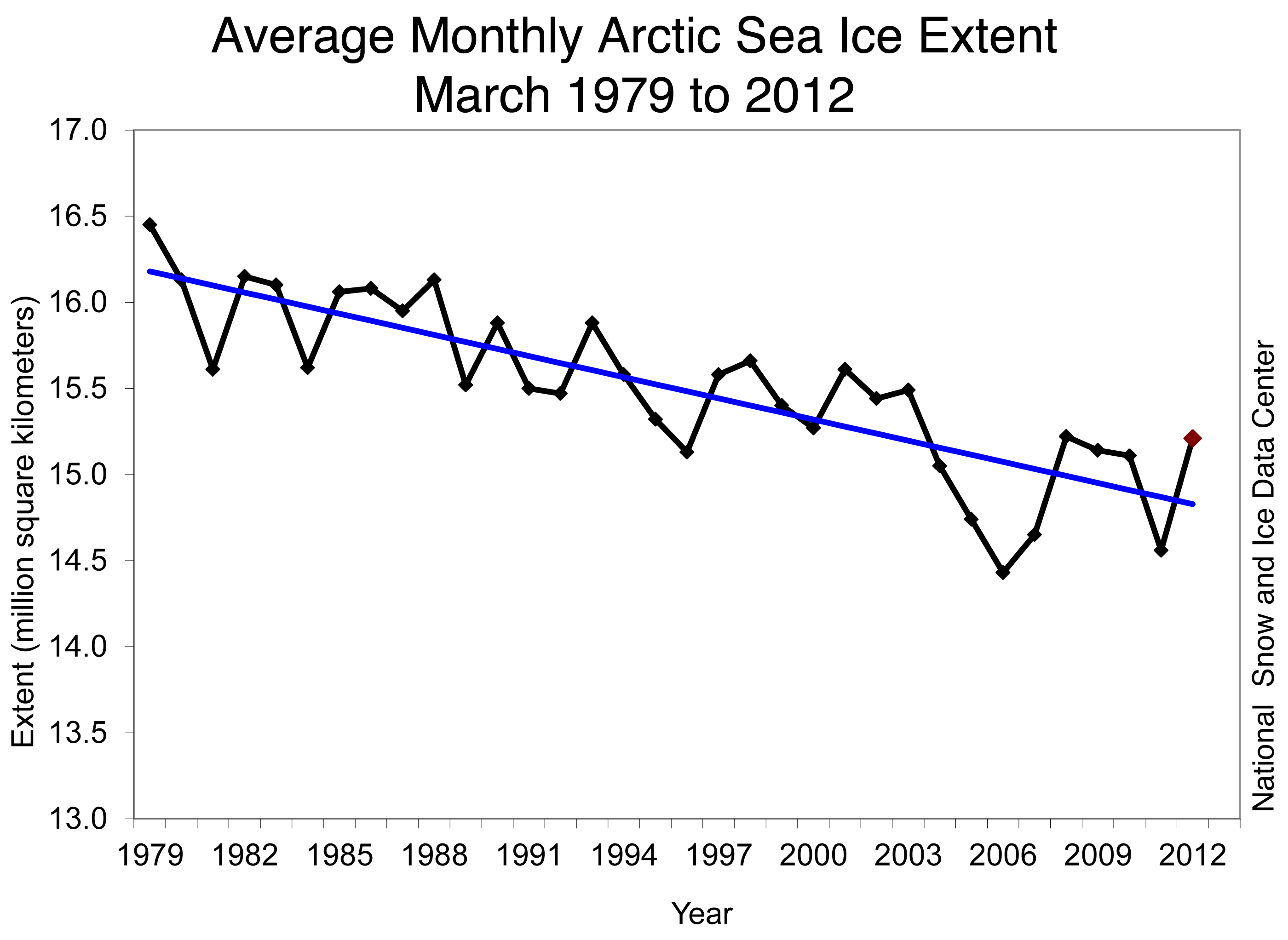
"Nor do I, especially the theory/belief that global warming's primary driver is CO2."
Ok I'll bite, if not CO2, then what could be the primary driver?
"I don't know if you have children yourself, but, I have 3 children, and two grandchildren, and I would never "emotionally blackmail" them, let alone allow someone else to."
I have two. Both pretty young. I came to an early realization that I did not want to leave a mess for my children to inherit. I grew up and took responsibility. It is time that the human race grew up and took responsibility. If that means Santa has to die, then so be it.
"The nature and scale of the problems we face as climate changes are yet to be determined with any accuracy. Temperature as an example is below even the lowest UNIPCC's predictions. "
Let's say your right and the problem is too ambiguous to resolve with any clarity. We can take the "wait and see" approach, however, I think when the evidence that will be sufficient to convince the rank and file and the diehard denialists it will be too late to do anything about it. I like to sum it up with this picture.
"Suzuki directed those comments at students, hoping to incite them. You are also taking it as a given that there is no dispute as to the severity or cause of climate change."
Someone needs to get riled up about something. As for taking it as a given about the severity or cause I would echo Al Gore when he said that the climate question was "a settled science". Of course being settled doesn't mean that there are not a few detractors, but the key is that whatever studies they've done or evidence they've uncovered, is not sufficient to convince their peers.
Of course there are many non-scientist detractors but you can see why I don't give their opinions much weight.
But let's say, for the sake of argument, it is only half as severe as the scientists say it is, isn't that enough to take action? Again refer to the above picture in the link.
"Every day new studies indicate things aren't quite as bad as we have been led to "believe.""
More often the case these new studies are misinterpreted like the Weaver study. Myself, I would look at where the preponderance of evidence is pointing, a la Michael Shermer, and that points to man-made climate change with CO2 as the mechanism.
"Take a moment and look at the history of communist revolutions around the world. They start out isolating one group, and the next thing you know 20 million of their countrymen, women and children have been erased."
You make one error in this parallel. Science is not politics. Science is not an ideology. I'm not saying that science cannot be politicized or used to support an ideology, but comparing a ideological revolution that is based on how decisions get made and resources get allocated to scientists saying "hey bro, we got troubles on the horizon" is a far stretch. But let the environmental degradation continue and you'll no doubt see a similar type revolution where millions get erased due to increasing scarcity.
"Interesting comment...in the context of global warming, perhaps if all extreme environmentalists threw themselves off a cliff the net reduction in CO2 would save the planet. They could start by drawing straws to see who would be honoured with the first sacrifice of the greater good...(sarc)"
We make the adult decision to make small but real sacrifices now (reducing our carbon footprint in a non-dying sort of way) , so we don't have to throw anyone overboard in the future. So the rational decision is to make the right decision while we still have the option to make a decision.
" And do you believe in the kind, gentle new world order government that is now being proposed by Suzuki, et al? Good luck with that one. All rights are limited by groups of people - e.g. governments and religions. I have no problem in Suzuki saying anything. But, for him to suggest only he and his believers should be able to speak on ANY subject, is immoral. I understand Suzuki didn't give one of your proposals the time of day. Under a Suzuki government, how would your beliefs fare?"
I find the thought of Suzuki as a supreme dictator quite amusing. It wasn't my proposal, but rather it belonged to a group I had associated with.
Suzuki has been alive a long time (perhaps it explains his grumpiness), long enough to have shed most of his political naïveté but in the end he is a scientist first. Totalitarian governments are not his forte.
I see you are still characterizing science as some sort of religion. Belief doesn't enter into the picture, belief doesn't matter; empiricism, observation, evidence, that is what matters. Suzuki doesn't frame it as eloquently or as gently, maybe because he is old and time is short, but ultimately he wants people to think first, then speak. Much of the damage to the climate change debate has come from the non-scientists. Scientists, through long habit, hedge everything they say. They deal with theories, they rarely use the absolute term "fact" even if in fact, it is a fact. The non-scientist deniers make free use of polarizing language, rhetoric if you will, that moves the masses who hear it. Politicians use this technique all the time and people respond to the projection of absolute confidence and certainty. Perhaps more scientists should take a page out of Suzuki's playbook, but I would just settle for being on the right side of the debate.
" I agree the status quo will not hold...however, I do believe given the current state of technology and Moore's law of exponentially increasing knowledge, within the next 20 years "free energy" will be a reality and we will begin the transition out of the oil age."
You'd really like Ray Kurzweil and Dennis Bushnell, I suggest the formers books and the latters video's and radio appearances. Unfortunately I think it is a dead heat, pitting the Law of Accelerating Change vs the Law of Diminishing Returns. Quite literally we may run out of the energy needed to sustain the complexity of society before we find the holy grail. Another reason to start this shift now. Climate change and Peak everything are very much entwined.
"I agree, and anyone who would support the limitation of freedom of speech does so at the peril of having it come back and bite them on their ass."
As you and I both know we already do support the limitation of free speech. We limit hate speech, the right to accuse someone of witchcraft, the right to shout fire in a crowded theatre and of course, slander. In Canada we have a reasonable limits clause written into our Charter. We should be against ignorant speech much like we are against driving while impaired. Both are done hastily and without much sound thought.
Monday, March 26, 2012
The Face of Education
Education Has Gone Astray
To get to a certain point we all need some basic instruction, how to read, how to write/type, and basic math. Once we have those skills we can quite easily take over the course of our own education, tailored to our interests and our strengths.
Nothing is more demotivating to a child than having to learn something they are absolutely not interested in and yet are forced to learn. Then why do it?
Why do we have mandated by law instruction until the age 16, when by the age of at least 7 they have acquired the rudimentary skills to continue down the path that they choose and at their own pace?
Think about why our education system is like it is. It is shaped by corporations, curated by government, and mandated by law to produce a particular subset of workers (not thinkers) that fit into the current economic and cultural milieu.
This would be acceptable except for the fact that the system is now failing our children. If the free market guaranteed some form of employment for the time spent in school it would be an equitable trade off.
However, what is happening is that the level of education required by today's corporations is insufficient, the governments are too broke to provide more subsidies and corporations will not step in unless there is a profit to be had.
Hence all further education investments are coming from private individuals to get their children a degree from a university. The result: a hoard of over-educated mail-room clerks.
The over production of young adults with degrees has raised the bar for those seeking employment. Why hire a high school grad, when you can get a University grad for the same price? All this on the dime of the private individual.
Student loans? One of the hardest loans to discharge through bankruptcy, essentially creating a self-reinforcing loop that requires young adults to:
1. Get a degree
2. Take on massive amounts of debt
3. Take the first job offered to allow them to pay that debt
Which drives down the ratio of labour cost to the level of education a company gets.
So why pay for the privilege of having a degree or a diploma when the same education can be had for the price of a library card and a good computer?
Some of the greatest innovators (see links) in history share a common trait, either they were self-taught, or they were kicked/dropped out of school and then self-taught. Schools, as configured, squash innovation and encourage conformity.
http://www.autodidactic.com/profiles/profiles.htm
http://en.m.wikipedia.org/wiki/List_of_notable_autodidacts
Grades are degrading.
Grades are a shorthand that teachers and employers can use evaluate the quality of conformity attained by the pupil. A student that receives mostly A's and B's is praised while another student that receives mostly C's and D's is looked at as performing at an unacceptable level. Grades are little more than branding, establishing social hierarchies before they are let out into the "real" world.
Creating a situation of scarcity, for example, grading on the curve, creates an environment of competition which discourages information sharing (often referred to as "cheating") which in turn creates an atmosphere of fear of being wrong. The result: a roomful of mediocre students who end up being mediocre adults who take no risks, stand for nothing, all for fear of being wrong.
Children are natural collaborators. Don't believe me? Watch them at play in pre-school environments, you will see them learn about games, structures, songs, in groups and often spontaneously. Ironically this behaviour is one of the first the education system tries to snuff out with rigid formations (desks in a row), rigid schedules (class time length, recess length, occurrence of lunchtime), no talking, and repeated discipline for the offenders (non-conformists) that do not fall within the range of "acceptable" behaviour.
What does a diploma tell you? Or a degree or designation? All it says is that the student knew the material well enough to pass a standardized test. It does not demonstrate or illuminate the passion or adeptness the student possesses with the material. The only way to know how well someone knows their field is to talk to them and better yet to have them talk to others that share their passion and expertise, thus both at once demonstration their ability and maybe learning something more about what they love.
The Way Forward
Provide the basics for our children: reading, writing, and math, which are the bare essentials that provide a platform to acquire more knowledge on their own. In short, once the children are able to absorb and choose the knowledge they want to acquire, then we allow them to do so. No grades are to be given, no diplomas earned, instead the child is allowed to pursue an education path as far as his or her ability allows them to progress.
Initially knowledge would be acquired through a Khan Academy-like environment (http://www.khanacademy.org) where the child watches/reads a section, then answers a number of questions at the end of the chapter, if they are right, then the child progresses to the next level. At some point when the child exhausts a particular path in Khan Academy then he or she "graduates" to partaking in discussion circles/forums where others share the same interest in furthering on the same educational pathway.
As they demonstrate a firmer grasp on the material, the collaborative environment of the discussion circles/forums will stimulate new theories, new material, and new ideas to pursue. As their knowledge increases they in turn reinforce or increase the knowledge of others. The one truth that they will hold is that novelty can come from anywhere and from anyone.
Tuesday, March 13, 2012
Z-Day 2012: A Review
Post Z-day 2012.
So I've had some time to let the speakers words sink in. I didn't stay for the main event as I had my brother-in-laws B-Day to attend to and to be frank I had more fun at because I found talking to normal people about the worlds events refreshing.
Regular joes, like my brother-in-law, do not, in fact, have their heads buried in the sand. They are usually fairly knowledgeable about politics and economics and the environment and are open to hearing different perspectives.
But I digress, I saw most of the speakers with the exception of dear leader. I figured I could catch that later on YouTube. Actually I could have caught the whole thing on YouTube and saved myself the venue money and parking/transit. But I felt I should at least see them in person once.
So where to begin? I'll start with a list of offenses:
1. Material abundance = misnomer
Let's call a spade a spade. Stop sugar coating this. What you are referring to is material sufficiency not material abundance. Enough to feed everyone? Yes, only if the Earth is managed carefully and at present rates of depletion and regeneration, but most importantly reduces levels of consumption. You allude that no one can have a 40 room mansion, but in truth no one can have a 2500sq ft house either. They are both unsustainable. I know why you frame it like this, because it is scary. But scarier is what happens if we don't rein it in.
2. Technology, although cool, is not energy.
It takes energy to make and energy to maintain.
3. Energy is certainly abundant but...it has to be available to do useful work.
I get into this more later.
4. Complexity
Refer to the Law of Diminishing Returns or as I like to call it the Law of Getting Thoroughly Crushed by Complexity. It trumps the Law of Accelerating Change.
As societies become more complex more energy is required to sustain that complexity. The reason why most great civilizations of the past collapsed? Too much complexity and insufficient energy.
5. Population
Let's have a frank conversation about the population. You've glossed this over with the twin tenets of abundant energy and technology, when that is really not the case. There are three ways to reduce the impact of the human ecological footprint, one is to vastly increase the land, energy and resources available, this is one of the least likely scenarios. Another option is to let the population crash, not a great solution, but doesn't require much planning. The third is to reduce individual consumption, this choice is by far the hardest and the second most unlikely because it requires that people understand the global ecology and that every choice they make has an impact.
So unless Doug manages to find us another handful of planets and truly doesn't believe in annihilation, then the third option is the way to go. Is it a tough sell? Sure it is, but do it consistently and do it softly. Live it if you can.
6. Wealth. (the resources/currency)
Also while we are at it let's have a frank conversation about wealth redistribution. It's not going to be voluntary. See point 7.
7. The rich. (people)
You can rarely educate away privilege and entitlements. Maybe try peer pressure. But seriously how are you going to deal with the gatekeepers who currently control the majority of the resources? Guilt? Puppy dog eyes? The current system works for them. If we enter collapse, it won't be them or their children dying. They don't have a dog in this fight.
8. The Viking.
Whom I thought might have been VTV with dyed hair.
9. PJ's vocabulary. (CFOX)
I get it, you need to project the intelligence, literally oozing out of your orifices, but let's be honest, it comes off sounding a wee bit douchey.
You want to be accessible, dipshit, not wall yourself off with words. You can say profound things using words of just a few syllables.
I am well read. This is not me bragging, I have a 4 fucking hour commute daily so I have time to kill by attempting to make myself smarter. It hasn't worked yet, but I am hoping for an osmosis type reaction.
But I digress, you will not hear me talking like I'm smarter than I am for the following reasons:
1. No one likes a smartass.
2. For fear I would trip myself up
trying to enunciate some of that
shit. For example, I avoid saying the
word "enunciate". I also avoid the
word "Kunstler" but for different
reasons.
Mark my words, this word salad will come back to bite you. Perhaps it already has in the legions who attempt to emulate you and piss people off with some regularity I.e. VOR. You've got nothing to prove, just be yourself. Unless of course that is "yourself" in which case just pretend I didn't say anything.
10. Freemasons.
If you have a conflict of interest allegation then make it. Something I've learned in my travels is that you don't need a nefarious conspiracy if everyones goal happens to be the same. Your movements premise is that there are systematic irregularities that generate scarcity and inequality, so WHERE exactly do Freemasons play into that analysis?
11. End of work.
Quit selling the "no more work" angle. You will be working, not for money, but because you want to and your community expects you to contribute. And you will be working damn hard at what you do.
When you say no more work or end of work as you know it, it makes the hard core anti-welfare, Ayn Randians and libertarians hate you a little bit. Instead focus on the hard work that volunteers do and just how rewarding it feels.
12. No more cars.
Holy Jesus you might as well say no more hockey. I get it, cars are big resource hogs that sit around 80% of the day, but in people's minds they see endless waiting at bus stops, crowding into a smelly cramped bus (which I currently do so I know). Lead with a palpable alternative first, if you can. Cars epitomize freedom and the first world living. You need to do a better sell job on this.
13. EROEI. Nuff said.
Ok maybe not...because the concept of abundant energy seems to be a non sequitur for your movement. "We can build wonderful things, don't worry, energy is plentiful". Yes, logically you can build wonderful things and yes logically energy is all around. But one does not follow the other logically because you need energy accessible to do the work and you need energy and material inputs to build the toys, neither of which is plentiful or accessible.
You are constrained by the laws of thermodynamics, and thus constrained by EROEI, when it take 1 barrel of oil to extract 1 barrel of oil (or whatever energy equivalent you'd like to use) it is game over.
Oil is the most flexible, energy dense substance we've ever discovered. There is not another energy source that has all three attributes that made our current society possible, scalability, energy density, and flexibility. Some may have one element or two but not all three.
14. Playing to the singularitarians.
Yes technology is growing exponentially, but so is everything else, resource depletion, population, ecological destruction, extinction. Seems to me we are putting our foot on the gas, headed for a cliff, with the hopes of catching the singularity as we fall off, like in an action movie, and rise like the Phoenix.
15. You call us techno skeptics but you haven't given us skeptics anything other than to poo-poo our apparent lack of common sense. You have shiny new toys, but these have to come from somewhere and that takes energy.
You got boundless enthusiasm in your hand, I see that and raise you some realism.
16. Marahall (even my iPhone autocorrects to Marshall)
Take some time with your editing. I was sitting watching Moritz's speech and he had on the big screen spelled "Marshall" as "Marahall" not once but twice. It is one thing to have something spelled wrong but when it is a name it is worse. Of course the irony is not lost on me that this was during the "Competent Communications" section. It comes off as lazy and sloppy.
17. Canadian stereotypes.
I realize this was played for humor, but the underlying subtext is that people are generally fearful and ignorant, and are fearful because they are ignorant. True or not, this approach lacks tact. If you are going to use humor, self-deprecation holds the audience and those external to your tenets, harmless. If you are going to hold the system accountable, don't make fun of people's ignorance. These are the people you want to reach.
Conclusion:
In the final analysis I was heartened that people showed up, even if not in overwhelming numbers, because it shows that these people are looking for a better way. I suspect, however, there are far more people out there like myself, who have grown disillusioned with magical thinking and have move on, looking for more realistic solutions.
Monday, March 05, 2012
Limits to Growth
This problem is not a liberal or conservative problem, it is not a republican or democrat problem. I would even go so far as to say this is not even a rich versus poor problem. This problem belongs to all of us.
Saturday, February 18, 2012
Last Snapshot to Complete the Picture
So someone else, I think it might be Cran Campbell, as I think he usually posts out of North Van posted the following:
If you don't like what Jamie Scott has to say, then how about some well thought out
political invective of your own. I honestly believe that one day there will be violent
insurrection here. The underclass is being heavily stressed by the current economic
ills. Real estate prices are causing rental rates to rise just as wages are going down.
Something has to break if we keep going like this.
If you have some ideas about this please post them. We need more folks putting blogs
on this site.
To which GF responds:
I have. And Jamie Scott has nothing useful to say. I've said that, too. Now go away, SE. You're a pest.
Of course by this time I have already invited Greg and his hordes to come post on my blog (remember post with a blogger ID and not as an anonymous coward and the comment is instantly posted). But I read that and I was a little miffed that Greg couldn't, after all this time, recognize the flavour of my writing compared to others. Of course it makes sense considering he probably didn't read a fraction of what I said. How else can you argue so hard for so long without willfully ignoring everything else that has been written?
My response:
I sign my posts. And I am somewhat hurt that after all this time, you still don't "recognize" me. Narcissism much?
At this point I'm not going to get drawn into yet another long drawn out debate in which I get flagged off, so I am a bit flippant.
Greg's response is pure old man complete with sitting on the porch and shaking of his little fist:
"Narcissism much?" What kind of English is that.
Again, you go for the unsophisticated, juvenile insult, doubtless because mature, intelligent debate is beyond your meagre talents. You're just a little shill, and always will be.
How nice for you that you have a private place to spew your sycophantic invective.
Now, go play!
Greg Felton, I have most definitely demonstrated I can engage in "mature, intelligent debate", it is you who seem to have a problem with it.
I'm sure you are trying to make yourself feel better about your mostly mediocre career by slumming it in CL, but I have nothing to prove. I've never been a journalist, or an author, nor have I been lambasted for my political positions (well, except by you), so please don't feel humiliated if your sharp biting insults sting much less than you intended. Your words must ring hollow considering how much time you put into the "energy suck" of CL to try to beat me down (words from your WCT interview ring a bell?)
Of course, Greg may or may not realize I have a complete record of our discussion. So after 45 days, CL may wash clear, but this blog will be "at all times, forever."
Update:
Greg updated his last comment by tagging on the following line:
BTW, I recognized you instantly; I chose not to acknowledge you.
Which makes absolutely no sense what-so-ever as he had referred to someone else as me, hence my "hurt" comment. If he recognized me instantly then he wouldn't have referred to me at all. Because a) it wasn't me and b)he chose not to.
Greg Felton is well and truly ridiculous.
Be Suspicious of those that Quell dissent
I think the major reason Greg Felton and I clash so often other than his disagreeable nature is that I think he can't keep up mentally and rather than admit ignorance he hides behind the facade of a peevish curmudgeon and tries to intimidate his challengers by insulting them and denigrating their intellect.
When that doesn't work he coordinates with his fans (he is an author after all) who flock to protect their idols honor and flags down those that disagree. And if your a careful observer it is not just people that disagree that get flagged but it is specifically people who disagree and launch a great defense of their premise.
Take for example, Slavery Boy, none of his rebuttals were ever flagged down, later the discussion on religion which became quite heated, no flags. Why? Because none of the rebuttals came close to touching Greg's analysis, which was spot on. I've been flagged a few times now, not for being overly insulting (which I have never instigated), but because I am of equal if not superior standing in the argument and often leaving Greg looking foolish. I am not a lazy debater, I do the legwork whereas Greg is either lazy or incompetent (relatively speaking) that after he exhausts knowledge of his specialities (i.e. Russian history, Israel, Zionism etc) he relies heavily on what amounts to bluster.
I have in the past invited Greg to debate in a forum where our answers are permanent and no one can get flagged due to the fact that the other side is losing. He has consistently declined. You have to be suspicious of someone who consistently chooses a forum that allows for the silence of dissent and erases all humiliations after 45 days.
For someone who trumpets the absolute nature of the right to privacy he certainly is no defender of the right to free speech. I suspect he employs his methods learned from others who have censored him in the past.
Is it that he is getting too old for this game? Is he losing his edge? He parrots his points over and over again like he is the only one talking, not dissimilar from a patient suffering from dementia.
I think it is time that Felton acknowledges his shortcomings and sticks to what he knows and leaves politics and political discussion to those that can.
Look at his last post in response to someone who commented on the downfall of a political forum when one person tries to dominate through insults. At first glance it could be construed as directed at me:
So true!
We need some Jamie Scott/SE repellant. SE's infantile behaviour has turned me right off.
"This place can get infested
Date: 2012-02-18, 2:06PM PST
This place can get infested with insulting and condescending commentary. It's the cesspool of political discussion on the web because you get the same person or persons that are hell-bent on dominating the discussion by means of personal insults and name-calling."
But look at the all important second paragraph that Greg Felton left off conveniently:
"I call it verbal violence. . . it's used by the cowardly because they only use verbal violence while safely hiding behind anonymity. They would never debate face-to-face using verbal violence because in a face-to-face setting verbal violence almost always leads to physical violence. In short. . . they're a bunch of chicken neck cowards best to be ignored. "
Look at the line "safely hiding behind anonymity". Then look at Greg's reply "We need some Jamie Scott/SE repellant."
I am not anonymous because I sign my posts. Jamie Scott always identifies himself. Greg, although I know who you are from your unique use of the language, you never sign your posts and try to hide behind your anonymity.
The post was directed at you, not unsurprisingly, you attempt to co-opt it for your purposes.
Subscribe to:
Posts (Atom)